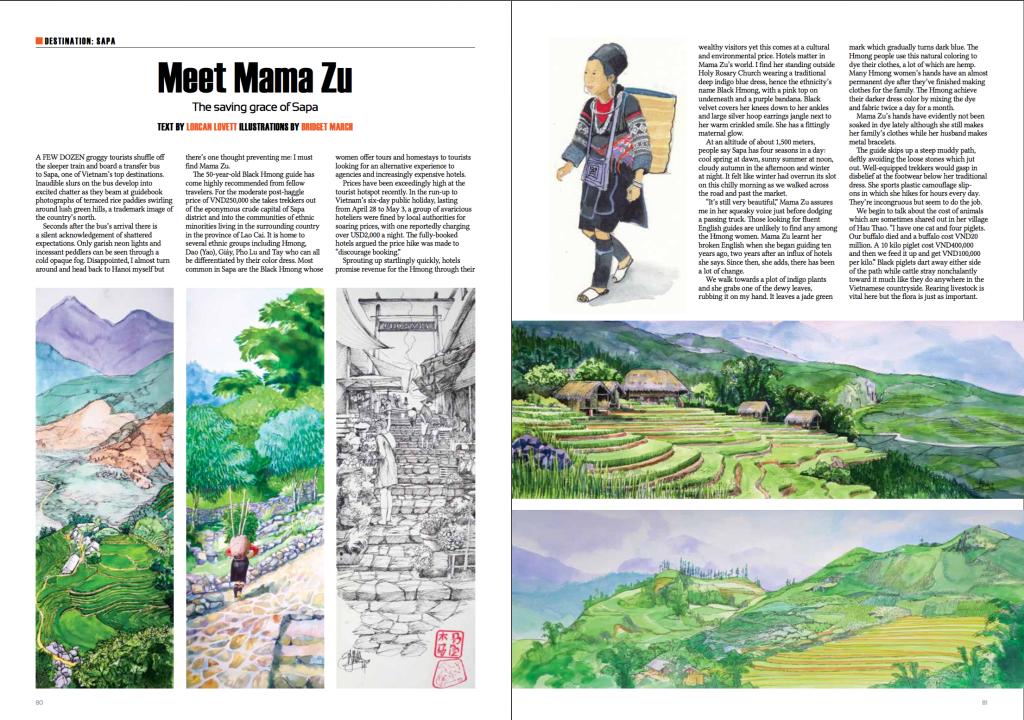
(Oi Vietnam, August 2015)
A few dozen groggy tourists shuffle off the sleeper train and board a transfer bus to Sapa, one of Vietnam’s top destinations. Inaudible slurs on the bus develop into excited chatter as they beam at guidebook photographs of terraced rice paddies swirling around lush green hills, a trademark image of the country’s north.
Seconds after the bus’s arrival there is a silent acknowledgement of shattered expectations. Only garish neon lights and incessant peddlers can be seen through a cold opaque fog. Disappointed, I almost turn around and head back to Hanoi myself but there’s one thought preventing me: I must find Mama Zu.
The 50-year-old Black Hmong guide has come highly recommended from fellow travelers. For the moderate post-haggle price of VND250,000 she takes trekkers out of the eponymous capital of Sapa district and into the communities of ethnic minorities living in the surrounding country in the province of Lao Cai.
It is home to several ethnic groups including Hmong, Dao (Yao), Giáy, Pho Lu and Tay who can all be differentiated by their color dress. Most common in Sapa are the Black Hmong whose women offer tours and homestays to tourists looking for an alternative experience to agencies and increasingly expensive hotels.
Prices have been higher than usual at the tourist hotspot recently. In the run-up to Vietnam’s six-day public holiday, lasting from April 28 to May 3, a group of avaricious hoteliers were fined by local authorities for soaring prices, with one reportedly charging over US$2,000 a night. The fully-booked hotels argued the price hike was made to “discourage booking.”
Sprouting up startlingly quickly, hotels promise revenue for the Hmong through their wealthy visitors yet this comes at a cultural and environmental price. Hotels matter in Mama Zu’s world.
I find her standing outside Holy Rosary Church wearing a traditional deep indigo blue dress, hence the ethnicity’s name Black Hmong, with a pink top on underneath and a purple bandana. Black velvet covers her knees down to her ankles and large silver hoop earrings jangle next to her warm crinkled smile. She has a fittingly maternal glow.
At an altitude of about 1,500 meters, people say Sapa has four seasons in a day: cool spring at dawn, sunny summer at noon, cloudy autumn in the afternoon and winter at night. It felt like winter had overrun its slot on this morning as we walked across the road and past the market.
“It’s still very beautiful,” Mama Zu assures me in her squeaky voice just before dodging a passing truck. Those looking for fluent English guides are unlikely to find any among the Hmong women. Mama Zu learnt her broken English when she began guiding ten years ago, two years after an influx of hotels she says. Since then, she adds, there has been a lot of change.
We walk towards a plot of indigo plants and she grabs one of the dewy leaves, rubbing it on my hand. It leaves a jade green mark which gradually turns dark blue. The Hmong people use this natural coloring to dye their clothes, a lot of which are hemp. Many Hmong women’s hands have an almost permanent dye after they’ve finished making clothes for the family. The Hmong achieve their darker dress color by mixing the dye and fabric twice a day for a month.
Mama Zu’s hands have evidently not been soaked in dye lately although she still makes her family’s clothes while her husband makes metal bracelets.
The guide skips up a steep muddy path, deftly avoiding the loose stones which jut out. Well-equipped trekkers would gasp in disbelief at the footwear below her traditional dress. She sports plastic camouflage slip- ons in which she hikes for hours every day.
They’re incongruous but seem to do the job. We begin to talk about the cost of animals which are sometimes shared out in her village of Hau Thao.
“I have one cat and four piglets. Our buffalo died and a buffalo cost VND20 million. A 10 kilo piglet cost VND400,000 and then we feed it up and get VND100,000 per kilo.”
Black piglets dart away either side of the path while cattle stray nonchalantly toward it much like they do anywhere in the Vietnamese countryside. Rearing livestock is vital here but the flora is just as important.
Bamboo shoots protrude through a thick layer of fog which settles below us. Mama Zu emphasizes her respect for the plant with a mix of enthusiastic gestures. She explains bamboo is used for construction in her village as well as having medicinal and nutritional purposes.
“You buy one from me”
Nearly halfway through the seven-hour trek we pass an isolated nursery which Mama Zu’s children had attended. She has three children, two of whom are adolescents and another older daughter who is 18 and married. She lives about three hours away by scooter after following the tradition of moving in with the husband’s family.
What do her younger son and daughter do? “They help make bags to sell and they talk to tourists,” she answers. “Their English is very good. They spend two days a week in Sapa and the rest in Hau Thao. When they are older they will work in the hotels.”
Mama Zu, who has two brothers, says her sister died two years ago and her mother is still trekking around Sapa at the age of 70.
Traversing the lofty hills of Sapa is hungry work. Luckily there is a stop for food in a wooden hut on the walk, a bowl of tasteless instant noodles included in the trek’s price.
There is a strong sales streak running through the Hmong. They’re encouraged to start trading young. One of their core tactics in capitalizing on the tourist boom is by selling their famous handicrafts.
Five little girls approach us, each carrying a bundle of colorful bracelets. They waveringly chant the slogan “you buy one from me” creating an almost eerie sound that soon fades away.
Understandably they’re more concerned with playing games and joking among themselves. At the hut a deaf mute boy wearing a sweater patterned with the US flag shoots me a shy glance and then juggles some stones, craving for our attention.
His infectious grin must be an uplifting sight for fatigued tourists. After playing with the child, we walk through the tiny village of Han Da, small wooden houses scattered around a school and church.
“In my village when the fog falls you see the big Catholic church too,” Mama Zu says, explaining that it’s not her faith. By now she is just plain ‘mama’ to myself and a fellow trekker. “Mama, what’s this plant?” “Mama, what’s that noise?”
She uses a combination of broken English, animal noises and her own language to explain. There are about four million native Hmong speakers in the world, of which 2.7 million are speakers of dialects that are mutually intelligible.
In Vietnam, the Hmong population is about 1 million strong and the dialect spoken by the Hmong in the north is similar to that spoken in Laos and Thailand. The basic words Mama Zu teaches us sound like “oua jow” for “thank you” and “gaw nyaw lee cha” for “how are you” although it’s not a leap to say the spelling would be very different.
On our return to Sapa town we see men working on a cluster of hotel developments which will boast views of Fansipan, Indochina’s highest mountain with a peak of 3,143 meters. The ground underneath turns into a smooth, new road. The boom town is stretching out its reach into the countryside.
I ask Mama if this relentless development can really be a good thing. She understands the question but shrugs her shoulders and says, “I don’t know.” Ahead we spot an old hunchbacked woman hobbling along the road. Surprisingly for us all, it’s Mama’s mother. After the cheerful family reunion the four of us finish the walk together.
Mama reveals a small book full of written praise from trekkers all over the world. Although she is unable to read it, she puts her blind faith in these references. We write ours. In a place seemingly filled with tourist traps, she has proved herself as a charming, authentic and affordable guide – the saving grace of Sapa.

































 Lorcán Lovett