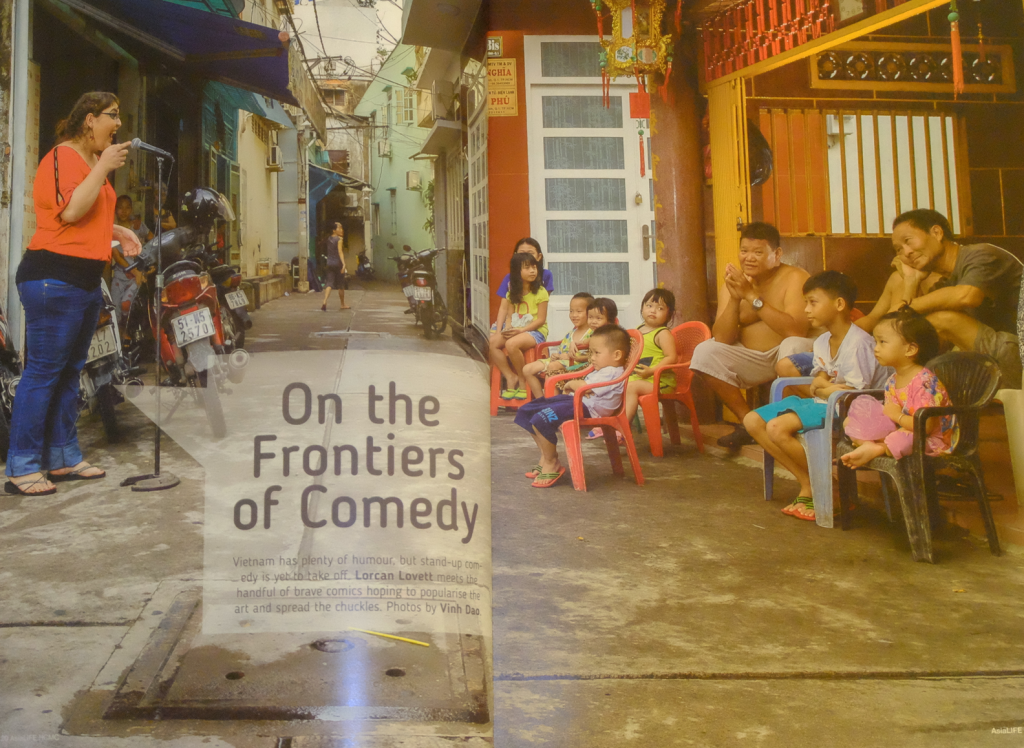
(AsiaLIFE cover, September 2015)
Vietnam has plenty of humour, but stand-up comedy is yet to take off. Lorcan Lovett meets the handful of brave comics hoping to popularise the art and spread the chuckles.
“You are at an amateur comedy show: it’s going to be terrible,” Steve Jackson, 32, half jokes to a couple, before dousing expectations at the next table in The Cube.
A small, upstairs room at the bar in District 1 is crammed with 50 people who have come here expecting to laugh; a simple but demanding ask, which Jackson and the rest of Stand Up Saigon hope to satisfy.
Accept, as the adage goes, nothing is straightforward in Vietnam, especially while your standing in the glaring, unfamiliar spotlight, trying to tickle multiple nationalities who are divided by their tastes in humour, but united by the universal habit of judging a performer.
Just as the jittery newbies take to the stage, the microphone fails. Stalling for time to fix the problem, Devin Monaghan, 26, implores the audience in his broad American accent to mingle without making each other laugh, because “that’s our job.” Fifteen minutes later, he’s back; this time to say the microphone will not work, and a night of bellowing out punchlines begins.
Monaghan, whose mop of ginger, curly hair lends a jovial look, appeals for any potential hecklers to keep quiet, considering they’re not professionals, before jibing at American legislation. “You can’t hold a full beer bottle but you can hold a loaded gun,” he shouts, and shortly after dubs customer service “the condom of capitalism”.
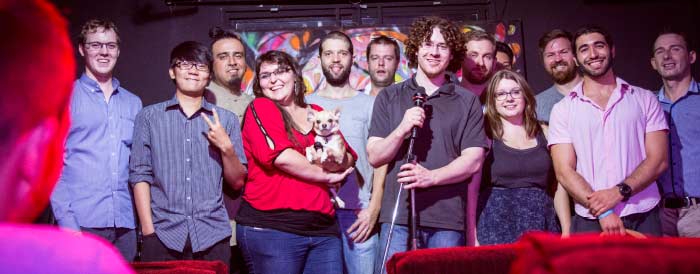
The closest thing to a heckle are crackles from the sound system which interrupt every act, sometimes getting more laughs than the stand ups by throwing them off their material.
Vietnam has about as much to do with stand up comedy as it does polar bears, so expats driving the scene have a tough job.
Attitudes towards the art may be slowly turning, however; audience member Manh Hao, 20, an intelligent, aspiring comic with hair flowing down his back, is living proof.
“I want to be like them,” he says, as the next person walks on stage. Hao learned much of his English from Cartoon Network.
He’s a Millennial, a generation which has shunned more traditional media like newspapers and radio in favour of the internet; one which has had exposure to all sorts of entertainment outside of Vietnam, including stand up comedy.
He says the only professional Vietnamese stand up is a former talent show contestant called Dua Leo. Then the next act timidly steps up and mumbles through her set.
People are biting their nails and drinks are being slugged down now. The following comic, another American, recovers the show and hands over to a Vietnamese man whose first move is to explain what types of jokes he’ll tell.
“I’ve been shagging a dirty cow,” the local says, finishing his set. “She’ll fuck anything that moo-ves.”
The lights cut out and people illuminate the stage with their phones. Then only one light, startlingly bright, shines above Hao’s table, giving him in almost messianic glow.
There’s about nine acts all together: British, African, Vietnamese, Mexican, German, and American. Anticipating the next performance becomes addictive, like rolling a ball on the roulette wheel.
It’s a warm-spirited event, with the organisers charging VND50,000 entry including a beer, essentially losing money themselves. So, what drives this audacious bunch to brave the chance of hearing crickets instead of laughs?
“I used to be a telemarketer,” says Monaghan after the show. “So the idea that a roomful of people would voluntarily sit and listen to me is too tempting to pass up.”
A few days later, Monaghan has joined Jackson for a coffee, along with Mick Noulty, 23, a blonde, fresh-faced teacher cum comic from Massachusetts, who moved to Saigon specifically for Saigon Stand Up (SUS).
The group was founded by Jackson and Dan Murray, who has since left, in 2010. It has about 20 members aged 19 to 45, only two of whom are women, although they want to attract more.
Jackson, a tall extrovert who retains the energy shown in his set, gained some previous experience in South Korea when he played characters like Raul, a washed up children’s entertainer, and a pious man complaining the bible was not hard enough on gay people.
After arriving in Saigon, a series of open mic nights banned him because “they wanted people to do Adele covers instead,” he says.
“Or shitty poetry,” Monaghan interjects. He launched SUS in Bernie’s Irish Pub (now The Dublin Gate) in District 1 and will leave it in the hands of Monaghan, because he’s going for a two-month stint at what he describes as a ‘fat camp’ in Thailand, after which he claims he’ll join a silent retreat for a month to meditate on his comedy.
SUS’s ground rules state to not purposefully offending an audience and always be prepared with well-rehearsed material. Members offer four free workshops for those considering stand up.
“We are more than willing to make their dream a reality,” says Jackson, “and help develop them to make sure they do not bomb first time on stage.”
Noulty, the quietest of the three, pauses. “Everybody was really supportive but I bombed the first night,” he confesses. “I performed in front of an apathetic half of the room and a drunk half.
“I bombed really hard and all those eyes I knew were on me. I forgot everything I was going to say and didn’t write anything down.
“It sucks to bomb, especially in front of your friendship group. All my friends were like ‘you did good, you did good’ and I was like ‘don’t do that, I know when I do well’.”
Noulty admits the nerves are still there, although it helps to “go out of yourself” and the last show, an otherwise bumpy affair, did offer an advantage for the young performer: there were no lights on the majority of the audience, so he was staring into darkness rather than daunting faces; it seemed to work.
“It felt like I did not perform in front of anyone,” he says with relief. “As soon as you are conscious of it, you are screwed. You start thinking what your lines are, your routine. The audience picks up on it and it’s a downward spiral.”
There’s another pause. “206 days dry!” a sober Jackson yells, for the fourth time. The team agrees heckles are rare in their shows; they have a supportive following, but it does happen.
“Some are friends,” says Monaghan, who laments audience members who shout his punchlines. “They do not know how to act at a comedy show. They would shout out an answer and then I would say my answer, which is the funny one.
“If someone starts heckling, deal with them easy, then harder, then, thirdly, say they would sound smarter if they shut up.”
Comics are not the only ones who can get agitated. Jackson talks about an episode in Bernies’s Irish Bar when a comic told the audience he had an imaginary pig, and then asked a person to kiss it.
He turned the invisible swine around and asked that person to now kiss it on the mouth.
One woman refused, and, under the comic’s demands, she got upset while the audience whooped.
“Doing it for the first time in front of an expat audience is different than in front of your own country men,” says Monaghan, who has stand-up experience in his hometown of Portland, Oregon.
“They do not share anything in common, so it needs to be funny to humans, not just Americans.
“But expats in general are interesting and weird. They just get it.”
SUS has a camaraderie where members either commiserate or celebrate after every show.
“We are all looking at each other, thinking we’re doing something amazing, doing comedy on the frontier of expat communities,” Monaghan says. As for the rare Vietnamese comics, Jackson reiterates Hao’s suggestion: Dua Leo is the best, if not the only one.
*****
Dua Leo, 33, sits at Trung Nguyen coffee shop, momentarily lowering his spiky, well-gelled haircut to sip on green tea.
“I want to be famous,” he declares. “Look at me; I’m not handsome, I do not sing. The only thing I have is good humour and I can make people laugh; that is easy.”
Leo crashed out of the second round of Vietnam’s Got Talent four years ago. He left on bad terms with the show because he says they edited it to make him “look dumb”.
Still, Vietnam had never seen his kind before: a man holding a microphone, talking about life. Forward to 2015 and he has more than 270 thousand likes on Facebook collected over five years as a professional comic. Isn’t he famous already?
“I’m kind of famous. Famous and kind of famous are two different things. When people see famous people on the street they go ape-shit crazy, but when you’re kind of famous they do a double-take and talk between their teeth (saying) ‘look at him,’ ‘oh it’s him’.”
Leo says he’s the only professional stand up in Vietnam, where the variety show rules and people feel more comfortable with slap stick, cross dressing and a sing-song than an observational rant.
He wants to shake up the old format because, he explains, some younger people are searching for new forms of entertainment.
“The younger generation praises me a lot, but the media takes me as some kind of vulgar actor who prays on dirty topics,” he says.
“Sometimes I think I was born in the wrong country. There’s no stand up comedy here. Before I started there was nobody and I’m the one to bring it.”
Leo does three 40-minute gigs a week in Vietnamese at coffee shops in Saigon. The audience aren’t allowed alcohol to “maximise the laughs and minimise the damage,” he says.
“In Vietnam (humour) is heavily cultural and regional. But for me, everywhere I go, I’ve killed (‘been successful’ in comedy jargon).
“I killed all the audience because my comedy is based on life. It’s not based on the place or the culture.”
The comic was a victim of Agent Orange, causing one arm and hand to be smaller and lack more muscles than the other.
He briefly mentions the handicap in his shows. “This is my hand,” he says, waving it. “In a way it has had an affect. Maybe it is much greater than I think. I knew I would have to be even greater. Maybe my hand is one of the reasons why I’m here today.”
Leo represents the future of stand up in Vietnam, although he doesn’t intend to do it alone.
“There will be a lot more stand ups because I will train them,” he says. “One of my plans is to open some kind of school for stand up comedy.
“The rules are not hard, you just have to surprise people. There will be more stand up comedy like mine in the future. I do not mind competition. It is good for the overall and because I know I’m the best.”








 Lorcán Lovett