(AsiaLIFE, January 2016)
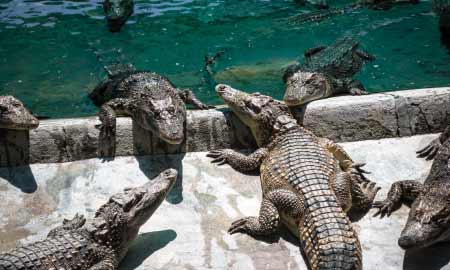
Commercial crocodile farming in Vietnam has soared since its introduction 30 years ago, with most of the activity taking place in the Mekong. Lorcan Lovett visits one of Saigon’s largest farms to explore the reptiles’ story.
On 29 September 2012, the bulky body of a Siamese crocodile was found floating in Ea Lam Lake in the central province of Phu Yen after being strangled with two steel wires.
It was female, 3.2 metres long and weighed over 100-kilogrammes; experts pinned her age at 100 years old. She was believed to be the last wild crocodile in Vietnam.
Throughout her century Southeast Asia’s wild crocodiles were brought to the brink of extinction because of their pliable, oblong scales that fed the appetite of the fashion industry, yet the value of their skin also spared them from total extirpation.
The turnaround came when a handful of pioneers began farming crocodiles for commercial gain in the mid 1980s, resulting in at least 1,000 farms of all sizes and the hundreds of thousands of the reptiles in existence today.
Former Saigon Zoo vet Ton That Hung was a forerunner in the trade. After collecting a shipment of 100 crocodiles donated by Cuba for the zoo in 1986, he considered starting his own farm.
The following year he purchased 3,000 square-metres of land in District 12 and raised two parent Siamese crocodiles, eventually opening an on-site restaurant which served the relatively unfamiliar crocodile meat to an excited following of patrons.
Curried crocodile is all good and well, but Hung knew selling the hide would generate some serious revenue.
At this point in 1994 Vietnam became a signatory of the Convention on International Trade in Endangered Species of Wild Fauna and Flora (CITES), meaning that with the organisation’s approval, people could raise endangered animals including crocodiles for the purpose of international trading.
Hung got approval through founding Ca Sau Hoa Ca Limited in 2000 on the same farm that he had raised the Siamese crocodiles, and established Lang Ca Sau Sai Gon, or Saigon Crocodile Village, partnering with HCMC Government, in the same spot three years later.
The craft village is built on a swamp with bridges reaching over ponds to thatched huts where visitors can find a restaurant, tannery, leather shop and soon a clinic.
A model tiger guards the welcome sign, one of the two apex predators to roam around this part of Saigon three centuries ago.
The other more prehistoric one still lurks beneath the algae albeit under the calculated eye of man.
Including its breeding farm, the village has over 20,000 scaly inhabitants. Their meat costs VND 129,000 to VND 239,000 per kilo, depending on the cut, and the whole hide is sold at VND 39,000 per cm measured around the belly.
The mainly decorative head is more expensive, says the farm’s communication officer Ng Thi Thuong, 32.
She sits next to an impressive $500 example in the site’s leather shop, its jaws pointing towards handbags worth up to $900, many destined for Europe.
“We have had less tourists this year,” she says in Vietnamese. “The main ones were Russian but the global crash and weak economy means less come now, however the local market has exploded.
“Income in Vietnam has risen dramatically so local people can afford the products.”
Thuong says people buy the leather or meat as a show of status more than anything else.
As one of the nine certified by CITE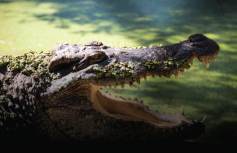 S in the country, the farm also sells a minimum of 100 baby crocodiles at a time at VND 700,000 for a 30cm animal, as well as selling meat to local restaurants.
The sporadic splash of tails against the water can be heard for those who turn left at the restaurant. A right turn reveals the relaxing warbles of a Vietnamese singer off the radio as 50 women tan the predators’ hides to make wallets, belts, watch straps and handbags.
Any leftover leather is used for smaller items like key chain and cardholders individually priced from VND 100,000 to VND 400,000.
Work is underway opposite the factory to build a clinic that will examine and potentially diagnose children for osteogenesis imperfecta (OI), also known as brittle bone disease.
It’s estimated that one in 20,000 people are affected by the bone-weakening condition that raises the likelihood of persistent fractures, and there’s no known cure.
In traditional eastern medicine, crocodile bone is slated to encourage blood flow, reverse calcium deficiency and alleviate rheumatism.
Just as Hung capitalised on the leathery by-product from his restaurant years before, the collagen-packed bones invited opportunity.
He began cooking the bones into a form of gel that was used by HCM City’s Traditional Medicine Institute (HTMI) to treat osteomalacia, and five years ago his suggestion of harvesting the reptiles to help OI children was developed into a programme combining medication, nutrition and therapy. Tuoi Tre News hailed the scheme a success last winter, citing the progression of two young twins.
Patients who have the condition will be taken a kilometre up the road, away from the crocodiles, and treated with the animals’ skeletons.
Hung has transformed a near-extinct species into a meal, a fashion accessory and now a medicine that hopes to cure a heart-rending disease, one that leaves children crippled in the hands of their helpless parents.
The Siamese crocodile has increased its owners’ profit at every stage of its utilisation, but ask the staff: this cash cow can bite.
Farm caretaker Pham Minh Duong, 31, who speaks about the animals with passionate admiration, has suffered multiple nips when moving the babies – who are too small to be stunned – to the appropriate pool for their size.
“Every time I move (the bigger crocodiles) around the ponds I have to use an electric gun otherwise they will bite me,” he says in Vietnamese, brandishing his war-weary forearm.
“Of course I feel upset that they will die but it is another department that kills them. Even though I’m upset I bear in mind that crocodiles are not like dogs or cats. I shower them and feed them every day but if I get in there they will eat me.”
The 800 babies whose survival relies on the staff’s scrupulous care are lined up in six tanks and fed fish paste four times a week.
In another pond a 100-strong bask of one-and-a-half-year-olds await their twice weekly feeding time. Nearby, half that number but twice as big, scarily so, are four-year-olds awaiting theirs.
The oldest of the troupe (the species’ lifespan is still unknown) appear like stepping stones in a natural-looking swamp, one of them three metres long, 14 years old and missing half a leg.
Specimens from the farm have been re-introduced to Cat Tien National Park in the past 15 years. In captivity they breed during wet season, laying between 20 and 50 eggs which are guarded until they hatch.
Duong will look after the new batch. He comes from the riparian Mekong, a perfect environment for crocodiles that once terrorised the locals. In a growing trend, they now provide them with a living.

















 Lorcán Lovett