To be with children, to care for elderly relatives, to find work: civilians tell why they are leaving safe countries for a war zone
As the war crept closer to Odesa, Ann heeded the pleas of her friends abroad and fled to Holland. A month later, as she tried to calm her son over the phone while Russian missiles shook the Black Sea port city around him, she decided to return. “I couldn’t stick it,” she says. “I needed to get home.”
The 50-year-old mother moved through a crowd of women and children at Przemyśl train station in Poland on a Wednesday afternoon to board her train. “I do not care what will happen to me,” Ann says. “If something happens to my family, why do I need to live?”
As the war continues, and allegations of Russian war crimes reach the international community, it is hard to understand why anyone would risk returning to Ukraine. But since Russia’s invasion on 24 February, of the more than 2.5 million people who have entered Poland, about 502,000 are estimated to have returned. Official figures provided by the Polish border guard show that between 4 and 10 April, a total of 117,129 people entered Ukraine from Poland.
It is not possible to know who among those numbers are civilians as the figure includes aid workers and other officials, but volunteers on the border in the Polish village of Medyka say they saw an increase in the numbers heading back in the previous week. For men, the journey may be a necessary one, after Ukraine conscripted males aged 18-60 to fight.
Over the course of a week, the Guardian spoke to women at two different train stations, on either side of the Ukraine-Poland border, to find out why they were going home. They gave a range of reasons but many, like Ann, were motivated by a desperate desire to be with loved ones again. They were grateful for the support of their European hosts, but love for their family and home was pulling them back.
Advertisement
“We saw about 200 people waiting in line to go out to Ukraine the other day. At times there’s a surge of people going out,” says Ralph Yatsko, at a stand for World Central Kitchen in Medyka.
Jim Clayton, from non-profit Siobhan’s Trust, who has been handing out pizzas to people at the border for 11 days, says he has seen a definite increase in Ukrainians returning. “It’s nice in a way but also scary. It’s hard to know if they are going back into a dangerous situation.”
Fear of living in the besieged country is still very real. “If you heard the news, you know,” says a mother shepherding her two young children through passport control at the train station. Her parents need her care in eastern Ukraine, she says, though she is anxious to return to Poland.
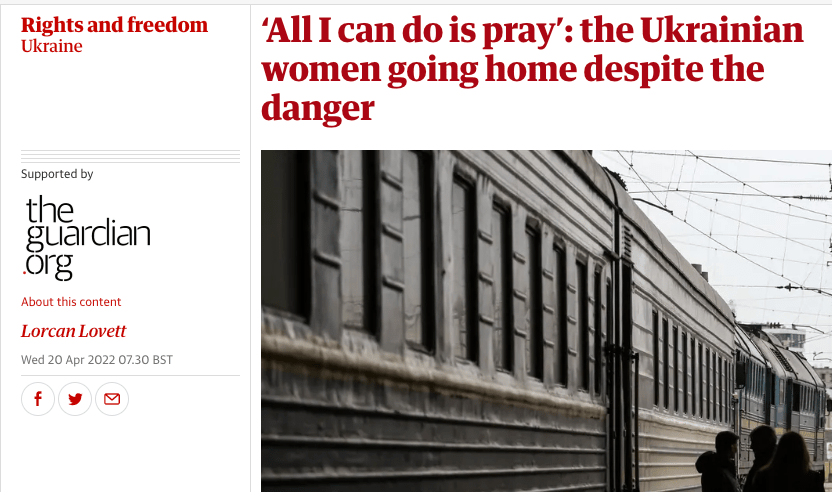
On the blue and yellow sleeper train to Odesa, smartphones light carriages with calls to loved ones, until the blinds are pulled shut to avoid the train being spotted by the Russians. Checks by armed soldiers and plainclothed Ukrainian agents delay the first stop at Lviv by two and a half hours.
In Odesa, Ann will join her son and his wife along with his father-in-law, whose home in Kherson was destroyed by Russian shelling. They were last together, sipping wine hours before the invasion, on 23 February – a Soviet holiday known as Men’s Day. It now feels like a lifetime ago, Ann says.
Advertisement
“I dreamed my son was hugging me and saying, ‘Please do not leave me again’,” she adds. “The atmosphere of my presence may help.”
On the same train, Tatiana, 57, is heading to Kolomyia, western Ukraine, where her mother has relocated after their apartment in the north-eastern city of Kharkiv was shelled. She briefly accompanied her daughter-in-law and grandson to Poland before going back to care for her mother and other elderly residents. Her Ukrainian friends in Germany are also returning to reclaim a sense of home that was lost in the flight from war.
While Tatiana’s 27-year-old son is in Odesa, her elder son, who is 34, has been unreachable for weeks. “He is a medic on the frontline,” she says. “I don’t know where he is, and he can’t call because of his security. All I can do is pray for him every day.”
Iryna, 29, has been in Poland for just a night before getting the train back. She took her daughter for biometrics so that the 10-year-old can obtain a passport and apply for a UK visa. After that, she says, they will move from Ternopil in west Ukraine to a host in Warwick, England.
“It was so hard to come back to Ukraine,” she says. “I need to take care of my baby. I don’t want her to feel I am worrying and crying all the time. If the Russian army doesn’t come to this part of Ukraine, it will be more rockets or something else.”
Her daughter plays with someone’s pet terrier as videos of Russian atrocities are passed between the adults.
Tatiana K, 58, from the western Ukrainian city of Khmelnytskyi, was having medical treatment at a Kyiv hospital when the invasion started. Her medical records were lost in the upheaval as the hospital was forced to close. She now travels across Ukraine for up to 12 hours to see a specialist cancer doctor in Poland.
“I did not believe in the possibility of war in Ukraine until the last day,” she says, looking exhausted and touching the dressing on her face from a biopsy. “Now I don’t know what to think.”
At Lviv train station a few days later, close to the border with Poland, returning refugees wait for train and bus connections alongside eastern Ukrainians, heading in the opposite direction after the horrors of a strike at Kramatorsk train station in the Donbas and an expected Russian offensive in the region.
Near the station, Yulia, 30, steps off a bus from Krakow with her two children and sister. Before boarding the next bus to her home town of Ternopil, she tells of how old Polish women had cried with sympathy for Ukrainians during her month-long stay in Krakow. “But I couldn’t find work [in Poland], and without work it’s hard. It’s easier to be here, this is home.”
Returning from Poland and now on a minibus bound for the western city of Kamianets-Podilskyi, Lyudmila, 59, hurls invective towards the Russian president, Vladimir Putin. “I would have never believed that the Polish would help us and the Russians would kill us,” says the grandmother, who spent half her life under the Soviet Union. “We don’t need to be liberated by the Russians.”
She has returned to care for her sick husband, while another grandmother, Helena, is travelling from Milan with her daughter and 10-year-old grandson back to their home near Kyiv, which they had left two weeks previously.
“A lot of people are returning to Kyiv and Kharkiv because they’ve heard it’s become calmer,” says Yelizaveta Sokolova, a volunteer at the station. “They want to be in the country they were born in.”
Uniformed soldiers crowd around a truck at one end of the station. “It’s very dangerous,” says one soldier, who asks for anonymity. “Many people are coming back but they need to wait longer. It’s too early.”







 Lorcán Lovett