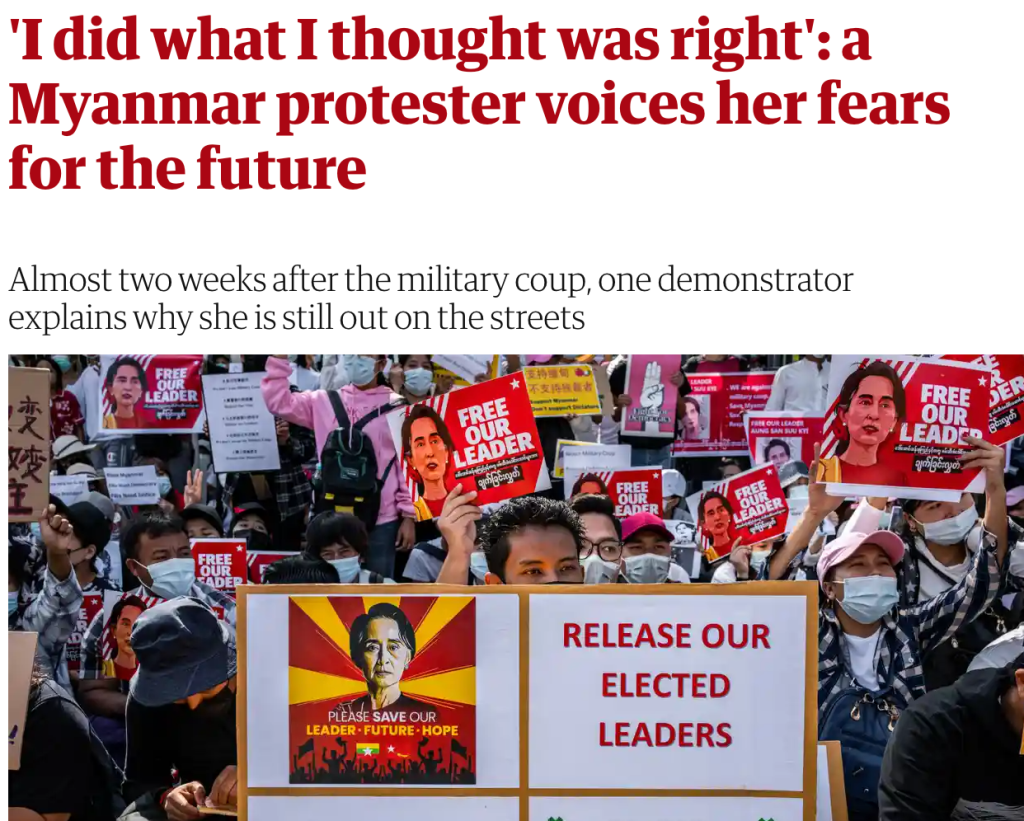
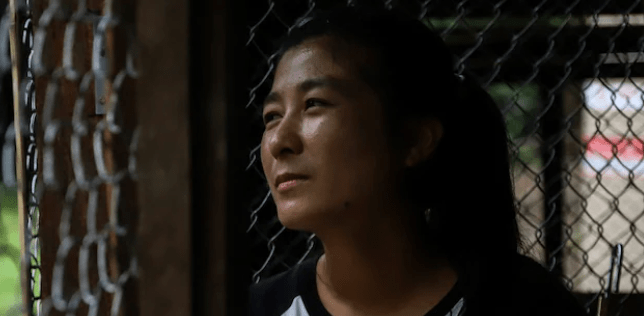
In previous years on Union Day – the Myanmar public holiday marking the agreement between ethnic leaders on 12 February 1947 to forge a unified country – Khin* had worn her traditional htamein, a snug maxiskirt. But since it would prevent her from running away if the police opened fire, this year she opted for loose trousers, large sunglasses, a baseball cap and face mask.
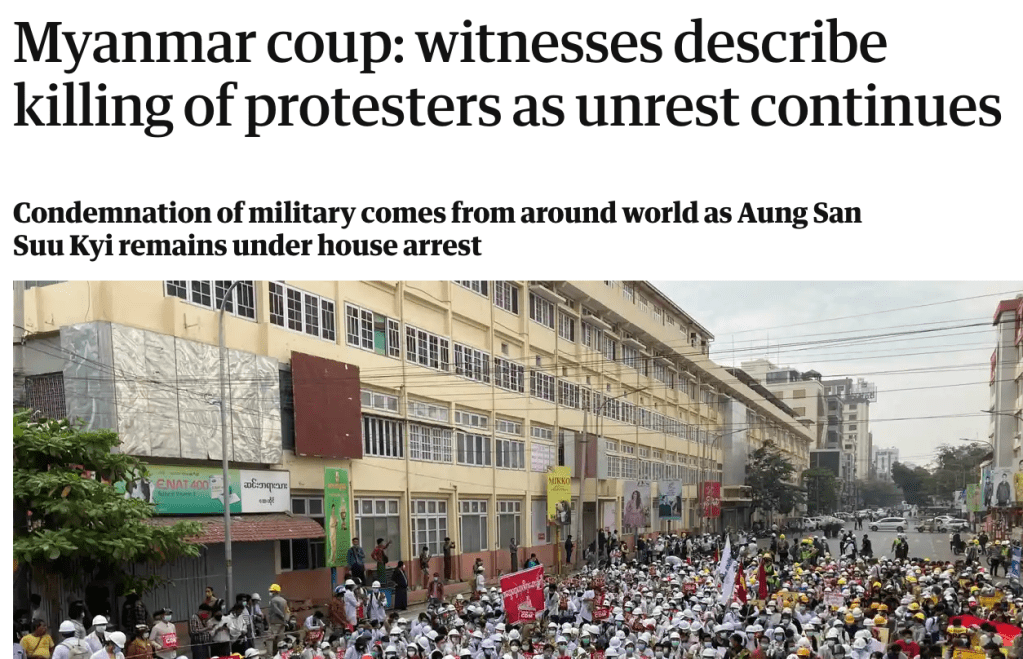
For the seventh consecutive morning she found a full-scale rebellion playing out on the streets of Myanmar’s biggest city, Yangon. A couple of thousand railway workers marched near her home as Khin, in her early 30s, reflected on a phone call she had just received from her father, a high-ranking official in the army, which seized power from Aung San Suu Kyi’s democratically elected government on 1 February.
“He told me to delete all my Facebook photos of the protests,” she said. “He said a military team is beginning to search through people’s posts, but I didn’t delete them. If they want to do something, they can do it.”
As Khin held a protest sign in a taxi, she concluded that her father must have used another Facebook account to see her photos, because she has blocked him and other relatives to conceal her anti-military updates.
“My uncles who are soldiers blame my parents for not guiding me correctly, but I did what I thought was right,” she said, adding that during the 2007 saffron revolution – a key moment towards Myanmar’s now halted democracy – she had been detained for two days.
She said she could not talk about the coup with her father. “If I do, I’m sure he would be on their side,” she said. “He has already told me not to take part in the protests.”
Her taxi went past a few hundred students chanting outside a colonial-era hospital – a remnant of another unwanted master, the British Raj – before it reached the Russian embassy, where Khin handed out signs to another crowd who opposed Moscow’s deepening ties with Myanmar’s new dictatorship, bellowing out Les Misérables’ Do You hear the People Sing?
At the Chinese embassy, there was a demonstration against the perceived role of Myanmar’s overbearing neighbour in the coup. Protesters describe feeling safer near embassies because corpses outside consulates look bad for the military.
Khin squeezed through the 5,000 or so people lining the road, looking down sporadically to stamp on photographs of the military chief Min Aung Hlaing taped to the asphalt. She bumped into a friend – so many friends acquired, old and new, through these protests, she said – and they briefly discussed China.
“If the military takes charge of our country, China will make a lot of investment that will only benefit the generals and not the people,” said the friend. Patients from a children’s hospital opposite climbed a wall to watch protesters perform a Chinese lion dance.
At the main demonstrations at Sule Pagoda, where Khin headed next, tens of thousands of people sang revolutionary songs. Street workers in their hundreds laughed outside the lobby of a luxury hotel, and motorbikes long banned from downtown – supposedly on the orders of a disgruntled general – belted around under bridges displaying anti-coup graffiti.
“The military didn’t expect so many people to come out,” said Khin. The world was unaware of the full details of the 1988 pro-democracy uprising and its brutal end “but now everyone can see”, she added.
She waved her “Justice for Myanmar” sign outside a cinema. “The military mindset is to obey orders, not to think about what is right or wrong,” she said. “People say they are brainwashed. My father graduated from military university and has served for more than 40 years – maybe he is brainwashed too.”
A faded poster for an Avengers spoof, dating from nearly a year ago when the pandemic closed down cinemas, looked down on Khin and her friend, a 23-year-old graduate.
“I’m proud of my generation, but I am concerned they are coming out just for fun,” she said. “We need to focus on what is happening. We want an Avengers: Endgame, not an Infinity War.”
* Khin’s name has been changed for this article to preserve her anonymity






 Lorcán Lovett