Nikkei Asian Review, 3 August 2022
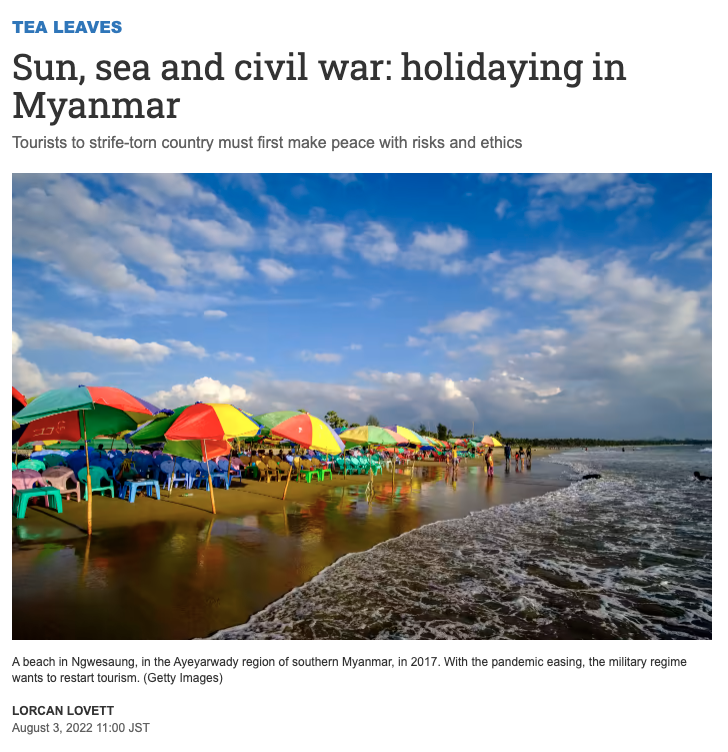
In the grand lobby of a Yangon hotel, a senior Myanmar tourism official told me she was meeting government officials to “rebrand” the country to focus international attention on pristine beaches instead of conflict and military atrocities.
It was March 2018, and Myanmar was governed by an elected civilian administration. But instead of standing up for the Muslim Rohingya, hundreds of thousands of whom had fled to Bangladesh amid a crackdown by Myanmar soldiers, the government was prioritizing a campaign to boost international tourism.
Tourism became increasingly important to Myanmar after the country began opening to the world in 2012. In that year, just over 1 million international visitors arrived, according to the Ministry of Hotels and Tourism. With travelers lured by the prospect of visiting some of the country’s famed historical and natural beauty sights, the total grew to 4.3 million by 2019, despite the military oppression of the Rohingya, before dwindling to virtually zero by the end of 2021 due to COVID-19 entry restrictions..
Now the pandemic is easing, and Myanmar’s military regime that took power on Feb. 1, 2021, wants to restart tourism, not least for the $50 visa fee and $50 minimum mandatory insurance that will be extracted from visitors.
The idea that international arrivals will paper over the cracks of an imploding country suits the rationale of regime chief Min Aung Hlaing, whose takeover triggered an uprising that will define Myanmar for generations to come.
So potential tourists face two difficult decisions: Is it ethical to holiday in Myanmar, and is it worth the risk? Glistening pagodas and dreamy sunsets may look less attractive against a background of escalating conflict.
The regime began appealing for tourists to return in late May — around the time when an explosion in downtown Yangon, Myanmar’s biggest city, killed a man near the Sule Pagoda, one of the city’s most famous temples. Closed-circuit TV footage shows a busy street flipped into chaos and panic, and a victim staring shocked at his own bleeding body.
Of course, Yangon carries on in what one local called a “bizarre new normal — calm on the surface, until you hear or read about another ‘incident’ which the regime blames on ‘terrorists.’”
Even before the military takeover, visiting Myanmar posed an ethical dilemma: Does the economic benefit to the country and its people justify turning a blind eye to military oppression and growing poverty? It is true that the even before the takeover, the collapse of tourism due to the pandemic brought real hardship to many.
Pyae, a tour guide at the UNESCO World Heritage site of Bagan, an ancient city in the central plain of Myanmar, told me that while the community and archaeological workers were keeping the area’s temples in good condition, the lack of visitors was crushing the local economy.
“People here are selling their rings, their cars and their land to survive,” said Pyae (not his real name), adding that his wife had been forced to keep working despite suffering from a serious illness. “I sold her necklace,” he said.
Across the country, retail sales are subdued as incomes dwindle, and traffic is thinning out amid soaring fuel prices. In a Yangon neighborhood where I once lived, street kids and other homeless people have become a common sight.
Even if you have trash in your hand, they will beg for it. Taxi drivers plead for loans, and any shred of trust in the military-controlled police force before the takeover has evaporated completely. People still talk of images on social media, of officers looking gleeful as troops shot at pro-democracy protesters.
Away from the city, civil war has reached popular beach towns in the Irrawaddy River delta and the royal palace in the historic former capital of Mandalay. Myanmar military soldiers are burning civilians alive, torturing children, boasting of slitting throats and forcing their victims to run before executing them.
More than 2,100 people have been killed by the security forces since the takeover, according to monitoring groups, and the regime said on July 25 that it had executed four democracy activists accused of terrorism. More than 1.2 million people have been displaced by military operations.
In the ancient town of Mrauk U in Rakhine State, people shelter alongside the domed temples, the former capital of a 15th-century coastal kingdom whose denizens included European traders and Samurai bodyguards.
Opinions differ, though, about the benefits of restarting tourism. “I don’t want some stupid foreigner taking random selfies with the locals and declaring we are fine,” said a social media influencer who feels it is impossible to post about anything other than hardship.
“Nobody here is fine,” she added. “Of course, cars are on the road, bars and shopping centers are busy, people still try to smile. But everyone feels dead inside.”
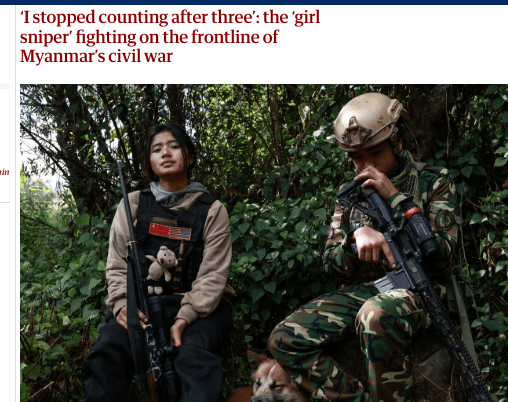
On the front line, two resistance fighters I spoke with via messaging app took a different view, despite the absurdity of being asked if tourists should fret about their consciences while airstrikes pounded the ground around them. “At least if tourists visit, they can tell others about the reality here,” said one who calls himself Htet.
Both said tourists should worry about the risks of visiting rather than the ethical issues involved, though they also encouraged visitors to calculate the direct benefits of their trips to the regime and donate an equivalent amount to humanitarian and resistance efforts. (Donations are best made once visitors have left the country.)
Like the tourism official I met in 2018, the resistance fighters also want to rebrand Myanmar — by ditching the military government and installing a genuine democracy. That is a rebranding exercise that the global tourism industry should get behind. Then the biggest dilemma facing tourists in Myanmar will be whether to order noodles or rice for breakfast.




 Lorcán Lovett