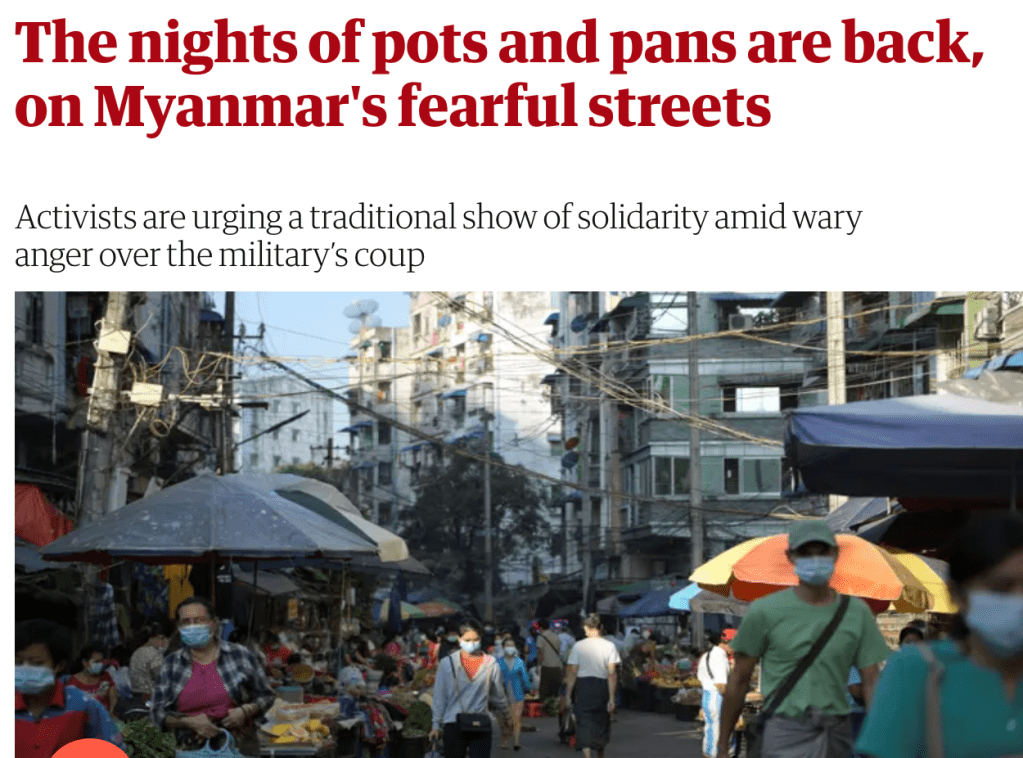
In Myanmar, if you want to drive evil from your home, you bang pots and pans. Yangon’s streets were filled with the din of clashing metal in 2007, when monks called for an end to military rule, and before that, in 1988 when the former president Sein Lwin, or the “butcher of Rangoon”, ordered troops to shoot pro-democracy protesters. On Tuesday night, pots and pans were back again.
Evil has returned, they say; Gen Min Aung Hlaing has led a military coup against the democratically elected government and its leader, Aung San Suu Kyi, whose immense popularity within the country helped her National League for Democracy (NLD) win a landslide victory in 2020. The military’s electoral proxy secured fewer than 7% of available seats, leading it, and the military, to claim widespread electoral “fraud” without evidence.
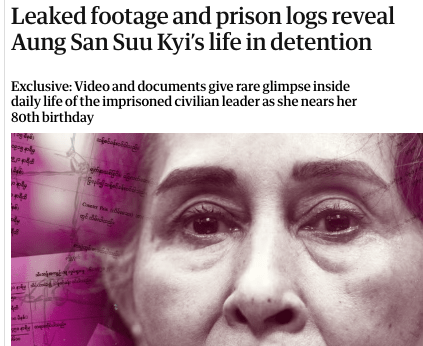
But now Aung San Suu Kyi is reportedly under house arrest in the capital, Naypyidaw, and the elected lawmakers who were to start a new parliamentary term and tackle the impact of Covid-19, poverty and ethnic conflict in the beleaguered country have been confined inside their government housing, surrounded by soldiers.
“People are feeling anger, fear and loss,” said a 24-year-old activist who asked for anonymity. “Now the international community’s involvement is key. The military must be pressured and made to feel alone.
“Japan, Korea and China should withdraw their development plans in Myanmar. We have seen that sanctions don’t have that much effect – I will leave it at that.”
At 8pm, the first rattles and shakes echoed down the streets of Yangon, rumbling into a chorus of cheers and spoons clashing against pans. Cars hit their horns, cyclists rang their bells and passersby smacked their hands against signs and stone.
This first public rejection of the coup went on for 10 minutes across the city in a massive show of solidarity.
Central Yangon had been quieter than usual on Tuesday morning, but people soon ventured out into a new, uneasy world. Queues that snaked from ATMs and supermarkets the previous day had dwindled, while telephone lines and mobile internet services that had been patchy since the first hours of the coup began to return. A form of normality was restored, though one fraught with anxiety over the next move either from the military or from the public, many of whom are not willing to accept another military dictatorship.
Kyaw, 80, a retired hotel manager, has lived through several coups and new constitutions in Myanmar, but he fainted twice after hearing that the military had seized power.
“It’s the youngsters who will be most affected,” he said. “It’s a very sad day for the country and our future. No good will come from this. As for those who have done this, I hope they burn.”
While military trucks remained outside City Hall in downtown Yangon and pro-military protesters gathered at a local park on Tuesday, the first stirrings of resistance emerged. A teachers’ federation called for the release of detained politicians and student leaders, Yangon Youth Network announced a civil disobedience campaign and doctors in Mandalay refused to work under the military junta.
Yoon, 18, a student, was jumpy, but hoped everything would go back to normal. “Everything has been disturbed and people are trying to adapt but it feels impossible,” he said.
Memories of the electricity and food shortages after the 1988 pro-democracy protests are still vivid for many – but even more the brutal onslaught brought by the military against protesters.
“In a country like Myanmar, there’s no such thing as feeling safe,” said Khin, a 29-year-old teacher. “This is one of the most bitter days I have experienced in my life.”
In the streets, some residents have quietly removed posters of the NLD to avoid the scrutiny of the military and its supporters, but to a larger extent profile templates of Aung San Suu Kyi and her party have sprung up on Facebook – Myanmar’s dominant mode of online communication.
“I’m disgusted about the people who have taken over our country,” said Tun, 19, who had returned from a US university to Myanmar during the pandemic. “The country is turning to garbage.”
Young or old, however, those who oppose the military understand what its soldiers are capable of. Instead of giving them a reason to shoot into a crowd, on Tuesday night they showed their solidarity with pots and pans.








 Lorcán Lovett