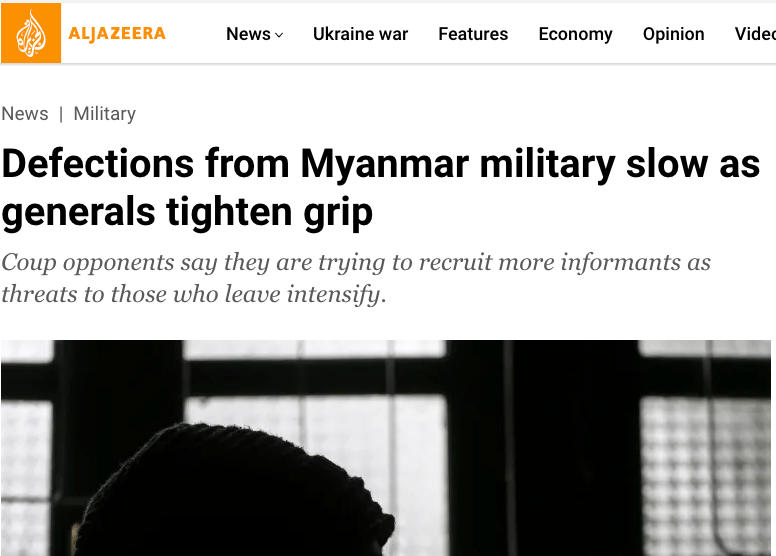
Mizoram, India – Aung Pyae paces outside the hillside clinic on India’s remote border with Myanmar.
The crackle of gunfire between his former comrades in the military and pro-democracy fighters a few hundred metres away in his homeland has eased, and all Aung Pyae can hear now are the moans of his wife.
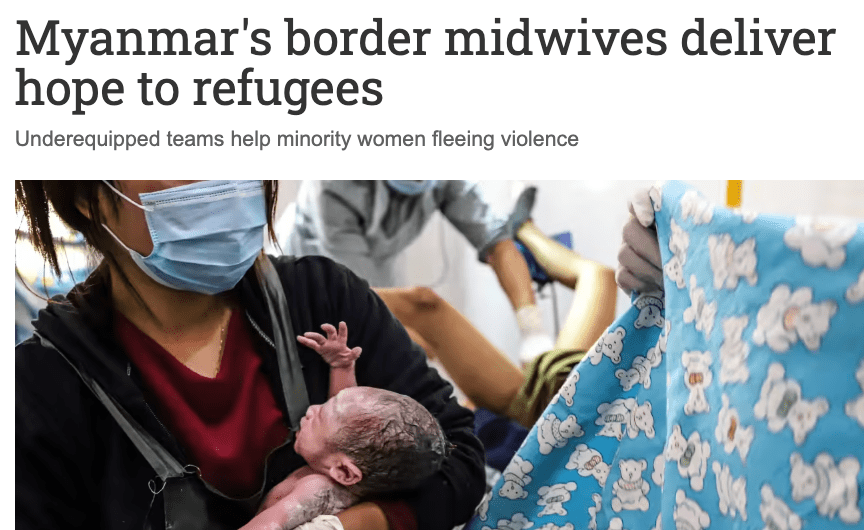
Her contractions are intensifying. A baby is on its way.
“My heart is jumping around,” said the 34-year-old, keeping warm next to a small fire outside the clinic with eight other former soldiers. Like him, they left the Myanmar military because they were disgusted at the generals who seized power from the country’s civilian government two years ago and then ordered a brutal crackdown on those opposed to their rule.
But now, even as the bloodshed continues, the pace of defections has slowed.
“If they wanted to defect, they’ve had plenty of time,” Maung*, a former soldier who now lives in Australia, told Al Jazeera over the phone. “It’s been two years and the military has already killed many innocent people.”
Local rights group the Assistance Association for Political Prisoners says the military has killed more than 3,000 people including civilians and pro-democracy activists since seizing power on February 1, 2021.
As military crimes emerge almost every week — from deploying helicopter guns on school children to burning people alive — the gap between soldier and civilian has widened. The public has even dropped the Burmese name for the military, the Tatmadaw, because they believe the meaning — ‘royal armed forces’ — is a poor fit for what the institution has become.
‘They began shooting at me’
Former army captain Lin Htet Aung, a co-founder of defector collective People’s Embrace (PE), said most of the roughly 3,000 soldiers and 7,000 police officers who deserted the military did so in 2021, the first year of the coup, and the numbers have since tailed off.
The number of soldiers who then defected to the resistance is unclear, but some are involved in weapons production, battlefield tactics and intelligence sharing for the revolution, according to the National Unity Government (NUG), which is made up of elected politicians removed in the coup and other pro-democracy leaders.
Many of the military’s 120,000 combat soldiers have been incentivised to stay not just by a regular salary — prized in Myanmar’s volatile post-coup economy — but also because they can make money by extorting those who travel through the ever-increasing number of security checkpoints that have sprung up, Lin Htet Aung said.
But it is not just about money.
The Myanmar military and the toxic mix of brutality and obedience to superiors that defines its foot soldiers has its roots in World War II when the Imperial Japanese Army oversaw the formation of the armed forces and provided training to founding members, including independence hero Aung San and future military dictator Ne Win.
It has dominated Myanmar politics for most of the years since independence and, even in the period of democratisation that was under way before the latest coup, was guaranteed a quarter of all seats in parliament and control of three key ministries, including home affairs.
Myanmar-born American scholar Miemie Winn Byrd said the institution was “more like a militant organised crime gang that no longer has morals or any code of conduct”.
“Their isolation has further fuelled their disdain for civilian authority,” Byrd, a former US army lieutenant colonel, told Al Jazeera.
Despite the reported discontent within the army, and reports that even the wives of soldiers are being forced to undergo combat training, few are willing to leave.
Byrd says soldiers and their families are consigned to military bases because of movement restrictions imposed by the leadership, as well as the threat of assassination from an angry public.
“The Myanmar military has always tried to segregate the military from the people,” she said, adding that officers especially are “brainwashed” into a sense of superiority over the rest of society.
In the years before the coup, the military was sometimes deployed to aid disaster relief — “rewarding missions” for some of the soldiers, she added.
“But the brass didn’t like it. They thought they [soldiers] were getting too close to the people and that when the time would come, they wouldn’t be able to order the soldiers to kill civilians.”
The military has long cast itself as the legitimate ruler of the majority ethnic Bamar people and a “protector of Buddhism”.
But Byrd says the military uses religion “as a tool to manipulate”.
“To kill and use violence to oppress people because they want to save Buddhism is grotesque,” she said.
‘Brutalised’
Most troops are indoctrinated and brutalised, said Maung, who added that “a higher rank hitting another soldier in the face is very normal”.
The armed forces are programmed to believe that their terror campaigns are righteous, he said, while anyone who questions orders faces beatings or jail.
“When I got here [to Australia], I came to understand the meaning of rights, and what it means to live like a human,” he said. “The military soldiers are brainwashed. The generals say that these [civilians] are terrorists you must kill, and the soldiers believe whatever the generals tell them.”
Following the initial defections, the military has stepped up monitoring soldiers’ communications and flooded them with propaganda.
Confidence that they will be welcomed on the outside is also faltering.
Aung Pyae said while many troops were willing to abandon their bases, “they know almost all soldiers who left are struggling right now so they are too scared to go, especially those with families”.
The anti-coup movement instead hopes to exploit the growing discontent by expanding its network of informers inside the military, who are dubbed “watermelons” — a green uniform masking a red interior representing the revolution.
“We have thousands of watermelons across the regions of Burma,” PE’s Lin Htet Aung said. “A lot of watermelon soldiers connect with our local teams to share their information.”
Aung Pyae’s friend Win Myat, a former officer who still sports a crew cut and wears his combat boots, says there is a growing resentment between the lower ranks and the higher echelons of the military.
“The military leaders see us as nothing more than dogs,” he said. “In fact, they treat us worse than their actual dogs. They look down on us while they go on living comfortably.”
Escaping the system is dangerous, however, according to the defectors.
Walking off base risks a three-year prison sentence, or torture and possible execution, and exposes family members to retaliation, Kyaw, a former sergeant, told Al Jazeera. Even the most stealthy journey to resistance-held borderlands can be deadly, he said, recalling his escape.
The 30-year-old sneaked off his base in the early hours of May 12 last year after his commander learned that he had alerted dissident teachers about a planned raid. Sidestepping landmines, he was about 200 metres from the barracks when the barking of dogs roused the soldiers.
“They began shooting at me, and even tried to snipe me, but I ran and jumped off a rock face,” said Kyaw, who eventually reached a resistance group and has since advised them on military tactics.
“I took my gun to give it to the resistance so for us, it’s shoot to kill if the military ever saw us,” he said. “But the military is using the salaries of the Myanmar people and yet still killing them. All the soldiers know this, but they still choose to be there.”
‘Soldiers are brainwashed’
Myanmar’s military has become notorious for extreme violence.
In 2007, soldiers fired into the crowds joining the so-called Saffron Rebellion after they were told that the monks leading the protests were bogus and simply troublemakers who happened to be wearing robes.
In 2017, a prominent military-aligned monk told an audience of officers that violence against the mostly Muslim Rohingya was allowed because, as non-Buddhists, the Rohingya were not fully human.
The crackdown, which forced hundreds of thousands to flee into neighbouring Bangladesh, is now the subject of an International Court of Justice genocide trial.
Ethnic minorities along Myanmar’s borders have also endured decades of abuse from the military, whose ranks are largely drawn from the Bamar.
Back outside the clinic, the eight ex-troops, living hand-to-mouth in a shared house which sits in a valley dotted with refugee camps, agree that life was harder than they had imagined before they deserted.
They had dreamed of resettlement in Australia after news emerged in March last year that Canberra granted asylum to two former members of Myanmar’s armed forces.
“But now there doesn’t seem to be a chance of that, and there’s no work in India,” said Kyaw, the former sergeant, admitting he was oblivious to the asylum application process. “If we had the support, there would be a lot more like me.”
Only three ex-soldiers have been resettled in Australia, according to the NUG.
A spokesperson for Australia’s Department of Home Affairs said Myanmar nationals were a “priority caseload” within its humanitarian programme, which has 13,740 places for 2022-23, and visa grants “are subject to rigorous assessment, including health, character and security checks, which are conducted before individuals are granted a visa”.
It would not comment on “the circumstances or humanitarian resettlement prospects of individuals or specific groups”.
According to government figures, less than 500 offshore humanitarian visas and more than 150 permanent protection visas were granted to Myanmar nationals between July 1 and December 31 last year.
Defectors applying for asylum are thoroughly vetted, said Tun-Aung Shwe, the NUG’s Australian representative.
“If first-world countries are willing to accept Myanmar military defectors, that would shake up the military and the speed of its deterioration would be faster than before,” he said. “That would end the current crisis and bring the democratic transformation back on track.”
For Maung, Australia has been a “multicultural country” with “nice and friendly” people. Feeling “so lucky” to be resettled, he added that his English language skills had also come a long way.
“When I first arrived, I couldn’t even order a coffee, so I would call my friends asking them to tell the staff that I wanted a latte,” he said.
The world of lattes seemed a far cry from the clinic in northeast India, where Aung Pyae is searching frantically for a blanket.
He wraps it around his newborn — a boy, not a girl as he had hoped.
“I am just so happy to have a new baby,” he said. “I must have a vision for them. It’s up to me to make a plan for them now.”
*Names have been changed to protect identities.
Additional translation by Fox.






 Lorcán Lovett