Myanmar-Thailand border – At a secret gathering above a cafe in a town on the Myanmar-Thailand border, Ko Aye examined the inside of an Android phone alongside 10 fellow defectors from Myanmar’s military and police forces.
The trainer, an ex-captain in the Myanmar army, guided the group through the process of repairing a mobile phone, a skill that could help them build a future beyond the conflict they recently left behind.
Having fled the notorious institutions they were once part of, these former police officers and soldiers now live in Thailand, near the Myanmar border, where they are learning new skills to adapt to a peaceful civilian life.
“If Myanmar gets peace one day, I’ll return and repair phones there,” said Ko Aye, a transgender man, for whom the workshops mark a new chapter in a resilient life journey.
“Although I’ll have to practise on some broken ones at home first,” Ko Aye added with a smile, wearing one of his homemade tie-dye shirts – a craft he taught himself to earn money.
Mocked by colleagues about his gender during his time as an airport police officer, 31-year-old Ko Aye defected after the Myanmar military coup in February 2021.
He retrained as a medic with the country’s pro-democracy resistance movement and it was during that time that Ko Aye witnessed firsthand the devastation of air attacks on the civilian population who are resisting military rule in Myanmar.
Eventually, Ko Aye fled to Thailand in search of safety and mental recuperation.
He is now part of the first cohort of graduates from a vocational training programme launched by People’s Goal, an advocacy group for military defectors.
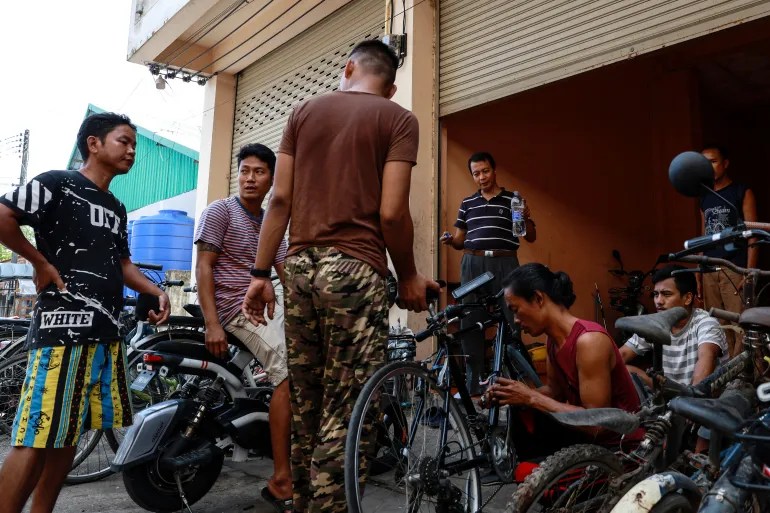
Alongside fixing mobile phones, the programme offers bicycle, e-bike and motorcycle repair training – skills that can help forge a new path for those who have taken part in years of waging war.
Many defectors from Myanmar’s army struggle to secure work and accommodation when they arrive in Thailand after fleeing Myanmar. They lack legal residency, exacerbating fears of being arrested by Thai immigration authorities and deported to their country, where they could face torture, long prison sentences, or even execution.
Fearing infiltration by military spies into their midst, most of the soldiers-turned-students on the skill training programme prefer to use aliases to protect their identities and shield their families from any potential retaliation back home.
“Our main goal is to give hope for people who want to defect,” said Naung Yoe, 40, a former army major who defected three years ago.
He explains how People’s Goal also provides safe houses, counselling and political education on democracy and human rights for the former members of the armed forces.
One of five directors of the organisation, Naung Yoe said the training courses also serve as a beacon for soldiers who are contemplating defection, as members of the armed forces often worry about what awaits them and their families outside the cloistered world of the military.
Myanmar is approaching its fourth year of widespread civil war, which erupted after the military removed the elected government of Aung San Suu Kyi in 2021, detained civilian leaders, and then killed people who peacefully protested against the army’s takeover.
According to United Nations investigators, reports of systematic torture, gang rape, and child abuse have escalated under military rule.
On both sides of Myanmar’s conflict, thousands of young people have been shaped by years of brutality.
A generation traumatised and desensitised to violence, with their education disrupted and ready access to weaponry, presents immense challenges for their reintegration into civilian life.
Naung Yoe estimated that by December 2023, approximately 10,000 police officers and 3,900 military personnel had defected or surrendered following the coup. He believes that number has since surpassed 15,000, although verifying the exact figure is impossible.
People’s Goal also cannot verify whether a former soldier who approaches them for skills training has been involved in war crimes, nor can the group sanction them for such involvement.
“Generally, those who have committed war crimes are unlikely to defect,” Naung Yoe said. “They never feel safe outside the military.”
If a former soldier confesses to crimes, however, the organisation will pass on information to investigators from international courts that are seeking evidence of such crimes carried out by Myanmar’s military, Naung Yoe said.
“Defections weaken [the] regime, and after the revolution, everyone who has committed crimes will have to face justice, somehow,” he added.
Former soldiers and analysts say Myanmar’s military brutalises troops, conditioning them to believe their bloody actions are righteous, but access to social media and smartphones has diluted that indoctrination.
Naung Yoe explained that soldiers – who are closely watched by their superiors – have less access to information than most of the population, but they are still aware the military is killing civilians.
“Those who opposed the killings enough defected,” he told Al Jazeera.
“But some defectors have gaps in their knowledge. That’s why we offer democracy training and work with civilian organisations to help them learn.”
Phone repairs trainer Thet Oo, 30, a former captain in the military, told Al Jazeera he was sceptical about whether vocational training could encourage would-be defectors.
Although he is willing to teach soldiers and police officers who have deserted later than others, Thet Oo said he has little time for those “who haven’t stood by the people” and remain in the military.
“I’m doing this training to help defectors provide for themselves and improve their lives,” he said.
“Enough time has passed for people to defect or not,” he added.
“Now only military power and pressure will lead to more defections and surrenders.”
In an alley noisy with whistling myna birds, tea shop chatter and clashing metal – in a scene reminiscent of Yangon, Myanmar’s biggest city some 420km (260 miles) to the west – three defectors tinkered with an e-bike.
Among them was Zaw Gyi, 46, a former warrant officer of 21 years in the military, who for the past month has attended a course for mechanics six days a week.
“I could do nothing but pray to get this opportunity because they chose from many applicants, said Zaw Gyi, who has relied on sporadic construction work in Thailand since defecting and fleeing Myanmar in May 2022.
“Despite a lack of trust, people still help defectors, so we have to be a good example for those who look at us with suspicion – an example that we can live together in harmony,” he said.
Back in the phone repairs class, Ko Aye said the training has brought opportunities for new friendships.
“We can understand and help each other,” he said.
One of his closest friends – his brother – also defected from the military. But he was captured by the army before he could escape the country.
“We don’t know whether he is alive or dead,” Ko Aye said. Still, he is certain that making the decision to defect was the right choice for his brother.
“As police, we should be public servants,” he added.
“We should not threaten or kill. That is what is happening in Myanmar.”









 Lorcán Lovett